When people put their minds together on social media, towards a common purpose, it generates more than just impressions: it really kicks butt. By all talking about the same thing, you’re creating “awareness” ripples in the anecdotal social media pond, that have the potential to touch other people.
With this strategy, 350 people in North Carolina were able to effectively out-trend the media’s favorite Frankenstein, Paris Hilton.
Here’s how.
The way SEO and organic content has always gone, since the dawn of the search engines, has been about creating pages, optimizing them around keywords, and then beefing them up through thousands of back end factors so that Google (or Bing, Yahoo, etc) think that those pages have more value than others – and therefore, show up better in the SERPs.
We can apply exactly the same strategy to social media platforms. There are similarly hundreds of factors that let Twitter, Google+, LinkedIn, etc, decide what content is “strongest” and should be placed in user feeds. These vary by network, but they factor in who is in your network, who has viewed your content, how many times it has been shared – and yes, which keywords are included.
Here is how it could work, in action: if you’re a hot dog manufacturing company Tweeting about hot dogs all the time, and your super engaging, hot-dog-loving user base is supporting you through sharing your content and engaging with you — there’s a strong chance you’re going to be weighed favorably in the hot dog space — by Twitter. Your content therefore has a higher chance to appear in the feeds of hot dog super fans you didn’t even know existed (because Twitter happens to know that that those people are out there, and that they’re really into hot dogs). Twitter also knows, at this point, that your content is something that hot dog lovers clearly care about. It *wants* to provide value to its end user. It wants to aggregate the right content for the right user. Twitter wants to help you get in front of the desired audience.
TLDR? Twitter and other social media networks connect your content to the end user, based on keywords. Organically.
There are other factors at play besides keywords. Frequency is definitely key. When multiple users begin to use the same hashtags, for example, with great frequency, they can trend on Twitter.
Here’s a specific example, replete with screenshot…
I developed a popular face-to-face event in my previous incarnation as RTP’s communications director: RTP180. A hyper-local, community-based, TED-style series, it took the form of a monthly dinner and a show. The audience of 350, largely from around the region, was passionate – and socially savvy.
At the start of every event, my co-host would encourage the audience to Tweet with the same hashtag — #rtp180.
We had a really great crowd, who really cared. And man, did they Tweet their faces off. So much so, that they succeeded in out-trending Paris Hilton, and showing up in Twitter’s coveted, must-pay-$100k-to-play-here trending box, like so:
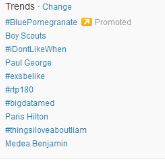
And that’s the power of content (and that whole engagement thing).
 erinmonday.org