
Today is Ada Lovelace Day, so it seemed appropriate to write about women in technology (and business).
As organizations, we try to make better opportunities, better environments, better investments in inclusivity. We train around unconscious (and even conscious) biases. And some are more forward-thinking than others.
But the hurdles remain.
So what is a woman in tech to do? How can we find success?
((Honestly, we shouldn't need to do anything special. We should just be ourselves. But that's not the world we live in. At least, not yet. A person's gender, race and orientation are still factored in more than the gifts of the individual.))
My more successful peers seem to fall into two buckets. The first is that of active and continuous re-conditioning.
Professionally, the most successful female leaders have one unifying trait: absolute restraint and self-control. In many cases they actively reject the stereotypes associated with femininity with every action they take and every word they choose. In place of “mood swings” and “wiles” they employ strategy, logic, restraint and patience.
Far more than the men at their level, they carefully control their emotions.
And they always make it look easy, seamless, flawless. To do anything less would invite criticism of their professionalism, or call to mind the stereotypical "histrionic" woman.
Some are naturals. But for many, this sort of poise doesn’t come easily: it takes work. A lot of work. Far more work than you could ever imagine. These brilliant women are effectively rewriting society’s rules – their very nature -- to be effective in the business world.
A female mentor at IBM, who had several years of managerial training under her belt, opened my eyes to this. She coached me on certain things that I had never thought of before. Such as: a woman in the working world should avoid making weak-worded statements, such as “I think” or “I feel.” And let’s not forget the worst offender: “Sorry.” After this epiphany, I noted that she was always careful to speak in calm, neutral tones.
In “Radical Candor” we see exactly that sort of hyper-neutral “optimal businesswoman” language at work in the exchanges between Sheryl Sandberg and Kim Scott. In communicating, the two women stick to facts, brevity and directness. They have mastered the tone and nuance of the self-possessed and successful female leader.
And there’s another end of the spectrum as well. Let’s call it “little to no conditioning”.
That’s where you’ll find me. You see: I’ve never really actively thought of myself as a woman.
Physically, visually, sure. Yes. I am a woman. It says so on my driver’s license. Mentally? I am not so sure.
I was raised by a single dad, three uncles, and a grandmother who'd had four boys and went straight from Catholic school into marriage and then motherhood. She seemed highly keen that my life be different than hers, vowing that I would "never, ever experience the nuns and their rulers." (Pictured below: barefoot w/dog).
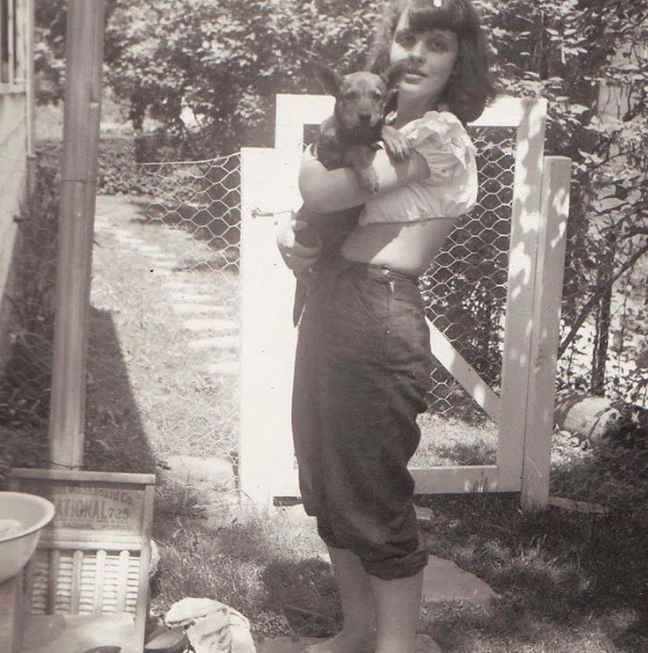
[[[Please note that this is the woman who ruined my "normal girlness" forever. My other grandmother, a proper Connecticut lady with an elegant blonde coif and no less than three white Jaguars, would see me for tea and etiquette lessons; touching on the appropriate usage of forks and doilies and such. Let us say she was promptly and regularly disappointed.. and we grew apart.]]]
So what does all of this mean? Well, the first 2/3rds of my life were insulated in a small suburban town. I was not taught about makeup or dresses or girly things – or any of the many ways ladies should think, or talk, or act.
Caring about appearance or attractiveness was not even a consideration. I was busy devouring libraries, climbing trees, catching fish, playing with rabbits and ducks and turtles, riding horses, cussing, driving go-karts and most importantly, questioning everything.
I didn’t watch much television or listen to popular music (barring anything that featured a horse, dinosaur or Weird Al). Nothing like that interested me much (video games, computers and books were another story; though characters like Scarlett O'Hara captivated and confused me, as alien as butterflies under glass).
What about boys? Dating? All that fun "coming-of-age" stuff? Well, in addition to the detractor of the three said Uncles, I'd been encouraged to pick my own attire from an early age. Fashion, to me, was a pair of boy's cargo shorts and a "Roadkill Cafe" t-shirt. Very sexy stuff. (Read: tragic).
Most of my early adult life was spent oblivious to the machinations of the the males of our species. Even today, if a gentleman is interested he basically needs to spell it out in neon lights (with a megaphone thrown in for good measure).
Ultimately, I am a woman raised by men, to think like men. And I am only recently beginning to understand how rare and powerful that is.
When I started my career and went out into the real world (my first gig ever was freelancing articles for Hearst, BTW), I was utterly oblivious to how adult women were supposed to act, much less women in business. I did not know how to acknowledge, leverage or use my own femininity.
I simply saw problems, and thought of solutions. Gender, or thoughts about how I "should" talk or act never really enter the equation. Stuff is broken? Acknowledge it. Then fix it. Efficiently and cost-effectively. Under budget and ahead of schedule.
The years have made me more aware, more thoughtful, at least as to the importance of "optics" or outward appearances. I understand now, logically, that women are "supposed" to act or look a certain way and it can absolutely hurt your career if you don't align. And I cater to that, just a bit: but mostly because it can be leveraged as an advantage.
After all, a female appearance can lead to all sorts of biases and stereotypes being applied -- leaving all the more room to plot and strategize behind mascaraed lashes.